
 Communal Cleaning
  Exterior Cleaning
  Building Maintenance
  Specialist Services

Landlords get fined when neglected maintenance becomes a health or safety hazard. Gas, electrics, alarms, damp, structure, and HMO failures trigger enforcement action.
Landlords usually don’t get slapped with fines for a tiny issue on its own. It’s more when a small problem gets ignored and turns into a bigger risk or even a legal breach. That’s when councils step in under the HHSRS rules, especially for category 1 hazards they must act on, and category 2 where they have discretion.
Key Takeaways
- Maintenance problems become fine risks when left long enough to create health or safety hazards under HHSRS.
- Gas safety, electrical checks, alarms, damp, and HMO management are the enforcement areas councils target regularly.
- Professional inspections catch gas, electrical, damp, and safety issues before they become formal enforcement problems.
Why Neglected Maintenance Turns Into Landlord Fines
Landlords are expected to keep the structure and exterior in repair. HHSRS looks at whether defects increase the likelihood or severity of harm. Minor problems (a dripping tap, a loose tile) become hazards when ignored long enough.
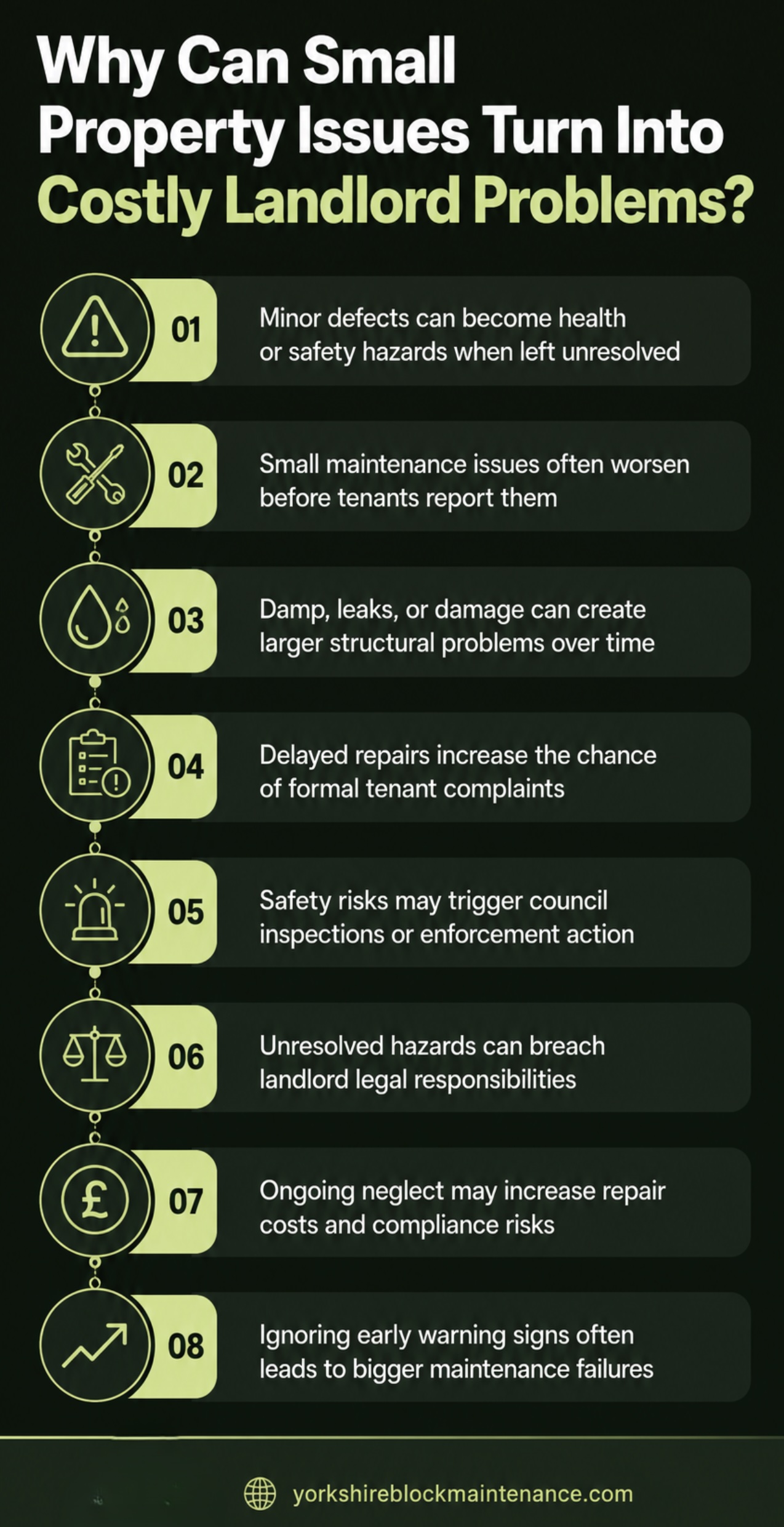
Landlord safety duties cover gas appliances, electrical installations, smoke and CO alarms, and keeping homes free from health hazards. Gas safety requires annual checks and record keeping. Electrical installations need inspection and testing every five years. Smoke alarms must work on each storey. CO alarms must work where required (solid fuel appliances, especially).
MEES sets minimum energy efficiency standards for private rentals. Properties must reach EPC rating E unless an exemption applies. Council enforcement follows when landlords breach improvement notices or HMO licensing conditions.
Housing quality remains a persistent problem across the UK. In 2023-24, around 1.9 million households were living in homes with Category 1 hazards, with over 760,000 of those homes having at least one occupant with a health condition, according to recent housing statistics. That is nearly 2 million homes with serious hazards that councils can enforce against.
15 Common Maintenance Failures That Lead to Landlord Penalties
The problems below trigger enforcement when landlords leave them unresolved.
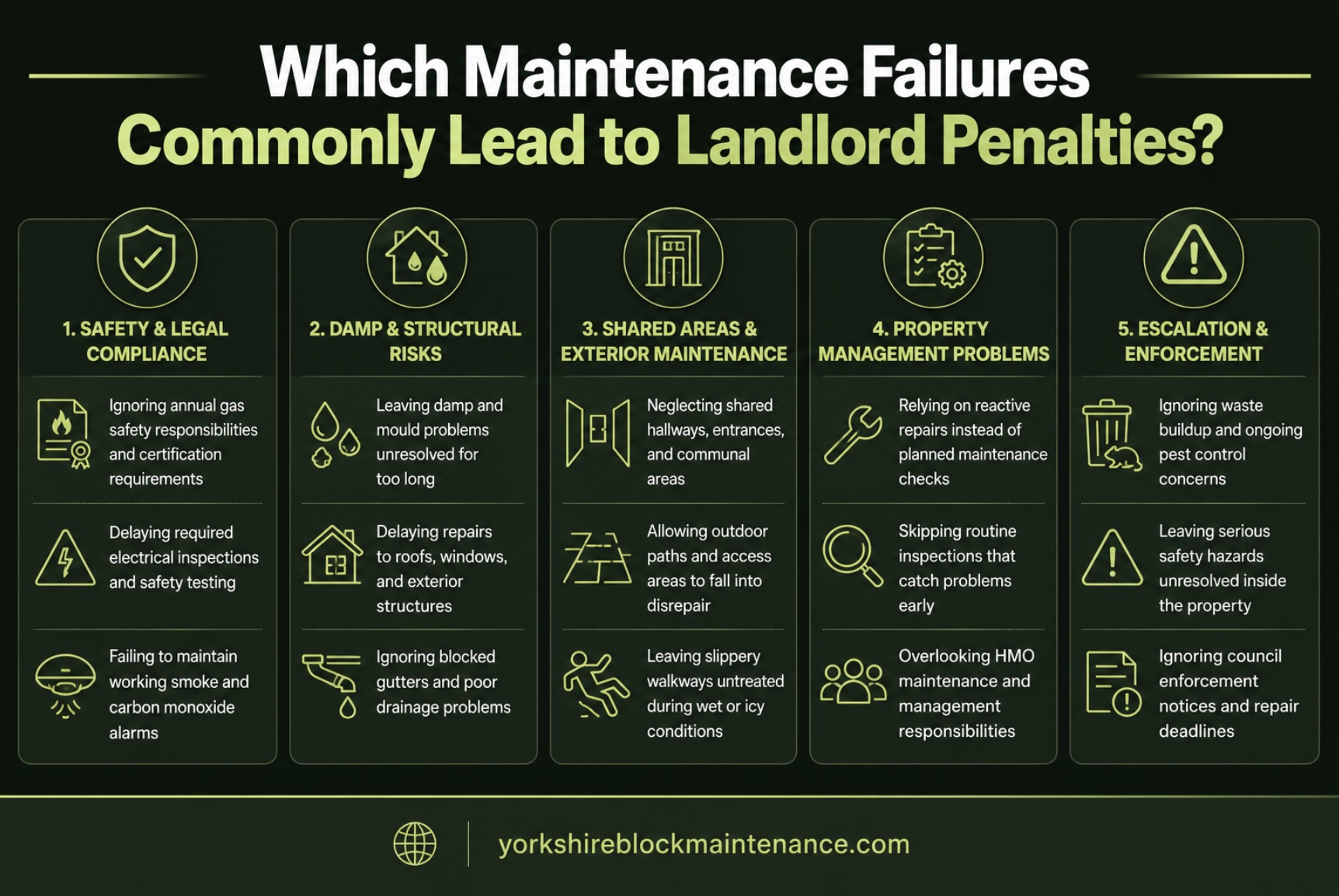
Each one represents a legal duty (or a hazard assessment) that councils can act on.
1. Ignoring Gas Safety Responsibilities
Annual gas checks are mandatory for all landlord-provided gas appliances. Qualified engineers must inspect appliances, flues, and pipework every 12 months. Records must be kept for two years and given to tenants within 28 days.
Unsafe gas appliances, broken flues, or poor ventilation create immediate danger. Carbon monoxide poisoning risk makes gas safety one of the most seriously enforced areas. Prosecution can follow fatal or near-miss incidents.
2. Failing to Update Electrical Safety Checks
Fixed electrical installations need inspection and testing every five years. A qualified person must carry out the inspection. The report must go to the tenant within 28 days (and to the council if requested).
Current regulations in England allow penalties up to £40,000 for electrical safety breaches. Faulty wiring, overloaded circuits, or damaged sockets create fire and shock risks. Landlords who skip inspections face enforcement even without reported faults.
3. Broken Smoke and Carbon Monoxide Alarms
Working smoke alarms must be fitted on each storey. Carbon monoxide alarms must be fitted where solid fuel appliances are present. Alarms must work at the start of each tenancy.
Local authorities can serve remedial notices when alarms are missing or faulty. Failure to comply with a remedial notice brings a fine of up to £5,000. The duty continues throughout the tenancy once faults are reported (not just at move-in).
4. Overlooking Damp-Related Property Risks
Damp and mould are not just cosmetic problems. They become Category 1 or Category 2 hazards under HHSRS when they worsen. Councils must act on Category 1 hazards once identified.
In 2024, 30% of households reported condensation, damp or mould. The figure reached 46% in the private rented sector. Around 1.4 million dwellings had surveyor-assessed damp problems in 2024. Private rented sector dwellings were most affected at 10%, compared to 7% in social housing and 4% in owner-occupied homes.
Serious damp triggers respiratory problems, mould growth, and structural decay. HHSRS enforcement follows when landlords fail to fix leaks (or improve ventilation, or address condensation causes). The council does not need to wait for a tenant complaint to act.
5. Relying Too Heavily on Reactive Maintenance
Dealing with problems later becomes a compliance issue when minor faults develop into hazards. Tenant complaints escalate when repairs drag on. Improvement notices follow when councils receive formal complaints.
Reactive maintenance costs more than preventive upkeep. Emergency repairs happen at premium rates. Tenant satisfaction drops when problems persist (and retention suffers as a result). Planned inspections catch issues before they reach the enforcement threshold.
6. Unsafe Communal Areas and Shared Entrances
Shared hallways, lighting, stairs, and escape routes need regular maintenance. Poor upkeep affects safety and fire risk. Blocked fire escapes, or poor fire separation (in converted flats, especially), create immediate hazards.
Broken lights, damaged handrails, or cluttered corridors increase fall risk. HHSRS specifically flags falls on stairs and level surfaces. Adequate handrails, lighting, and good repair matter because falls are common and serious.
7. Exterior Building Damage and Structural Defects
Landlords are responsible for the structure and exterior of the property. Roofs, brickwork, render, windows, and doors all fall under this duty.
Structural disrepair supports damp, fire spread, or falls. Cracked render lets water penetrate walls. Broken windows compromise security and weatherproofing (which affects both safety and energy efficiency). Missing roof tiles allow rainwater inside.
We provide exterior property maintenance services for landlords who need repairs done properly and on time. Professional upkeep prevents small defects becoming enforcement cases.
8. Blocked Gutters and Poor Drainage Systems
Blocked gutters, broken downpipes, and poor drainage contribute to damp, mould, structural damage, and water ingress. Overflowing gutters saturate walls. Water finds its way into cavities and internal spaces (where it causes hidden damage for months before anyone notices).
Landlords are responsible for sanitary fittings, pipes, and drains. HHSRS treats sanitation and drainage defects as hazards that cause infection and damp. Regular gutter clearance prevents overflow. Downpipe repairs stop water pooling near foundations.
9. Poor Grounds Maintenance and Outdoor Upkeep
Overgrown vegetation, broken paving, unkept yards, and neglected boundary areas create nuisance and trip hazards. Disrepair affects access to the property. Uneven surfaces cause falls (especially in winter or wet weather).
Landlords must keep outdoor areas safe and usable. Paths need clearing. Steps need repair. Boundaries need maintenance to prevent encroachment or security problems.
10. Slippery Surfaces and Poor Exterior Cleaning
Algae, moss, and grime make paths slippery. Ice-prone paths become dangerous in winter. Poorly maintained steps increase fall risk throughout the year (regardless of weather).
Surface treatments reduce slip risk. Regular cleaning removes algae buildup. Grit or salt provision helps tenants manage ice. Handrails give support on sloped or stepped routes.
11. Failing to Meet HMO Maintenance Standards
HMOs have extra management duties covering cleanliness, repairs, fire escapes, shared services, and fire equipment. HMO compliance is more than just having a licence. Management standards require active upkeep (not just paperwork).
HHSRS crowding and space concerns tie to health and privacy risks. HMO licensing failures can bring civil penalties up to £30,000. Prosecution with unlimited fines can follow serious breaches.
12. Poor Waste Management and Pest Control
Refuse buildup, bin store neglect, pest attraction, and hygiene issues affect shared or badly managed properties. HHSRS includes domestic hygiene, pests, and refuse as a hazard. Poor maintenance creates breeding places for pests and increases infection risks.
Bin stores need regular cleaning. Refuse collection needs managing. Pest problems need addressing quickly (before they spread to multiple units).
Our shared area cleaning and waste support services help landlords keep common parts clean and compliant. Professional management prevents complaints escalating into enforcement action.
13. Ignoring Serious Property Safety Hazards
Fire risk, falls, unsafe stairs, and poor lighting are HHSRS hazards that councils treat as serious. Category 1 hazards trigger mandatory council action. Fire is a core HHSRS hazard.
Landlord safety duties include keeping escape routes usable. Fire safety requirements apply to rented homes and HMOs. Blocked exits, faulty fire doors, or missing fire equipment create immediate risk (and immediate enforcement vulnerability).
14. Failing to Respond to Council Enforcement Notices
Councils serve improvement notices when hazards are identified. The notice sets out required works and a compliance deadline. Failure to comply brings further action.
Civil penalties follow non-compliance. Prosecution becomes an option for serious cases. Appeals exist, but do not remove the duty to act. Ignoring the notice makes the outcome worse (and the costs higher).
Compliance costs rise when delays continue.
15. Skipping Routine Property Inspections
Routine inspections help landlords catch gas, electrical, damp, leak, pest, and safety issues before they become formal enforcement problems. Regular checks identify developing faults. Early intervention prevents hazards forming.
Inspections should cover gas appliances, electrical condition, smoke and CO alarms, damp signs, structural condition, and drainage function. Record keeping proves diligence (if enforcement questions arise later). Certificates track compliance dates. Professional inspections provide independent verification.
How Professional Property Maintenance Helps Landlords Stay Compliant
Regular maintenance helps landlords prevent small issues becoming serious compliance problems. Routine inspections, fast repairs, and proper upkeep reduce the risk of damp, structural damage, safety hazards, and council enforcement.
At Yorkshire Block Maintenance, we help landlords stay compliant through exterior maintenance, communal cleaning, drainage upkeep, grounds maintenance, and routine property repairs. Preventive maintenance keeps properties safer, protects property value, and helps avoid costly penalties.
Conclusion
The cheapest maintenance is the one done before it becomes a hazard. Gas, electrics, alarms, damp, structure, shared areas, HMO management, and inspections all affect compliance. Small problems become expensive when ignored.
Professional support keeps properties compliant and tenants safe. Contact us for a free quote on property maintenance services across Yorkshire, and we will help you stay ahead of enforcement action.
FAQs
Can a landlord be fined for damp and mould?
Yes. Serious damp and mould can become a Category 1 or Category 2 hazard under HHSRS. Councils can issue improvement notices and civil penalties when landlords fail to act.
How much can a landlord be fined for safety breaches?
In England, penalties reach up to £30,000 for many housing offences. Smoke and CO alarm remedial notice breaches reach £5,000. Current electrical safety penalties reach up to £40,000.
What maintenance checks do landlords legally need to do?
Annual gas safety checks, five-year electrical inspections, alarm checks, and ongoing repair of hazards and defects. Records must be kept and shared with tenants.
What happens if a landlord ignores a council notice?
Councils take further action including civil penalties or prosecution. Appeals exist but do not remove the duty to act. Non-compliance costs increase over time.
Do the same rules apply across the UK?
No. Housing policy is devolved. Rules differ across England, Scotland, Wales, and Northern Ireland. The enforcement powers and standards vary by jurisdiction.